
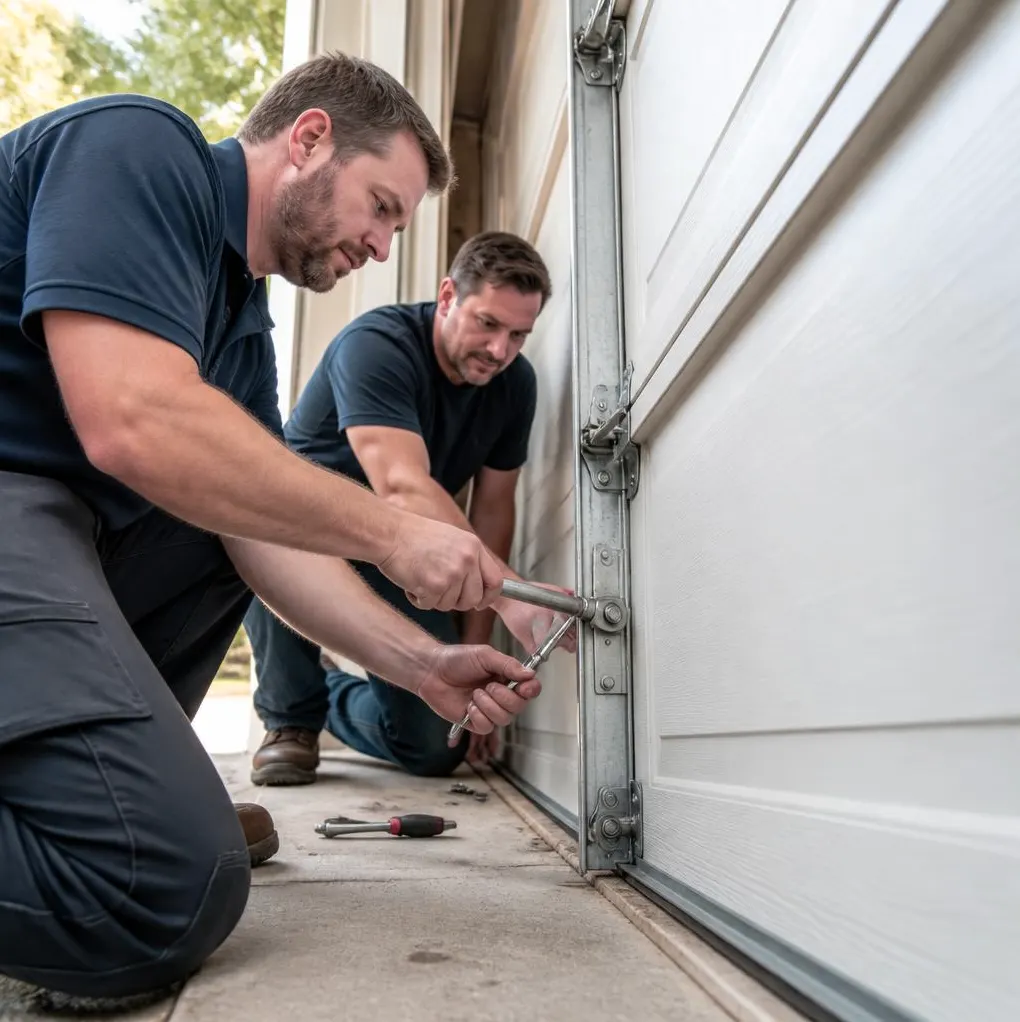
What a Technician Sees on These Calls
The call usually comes in a day or two after a wind event. The homeowner describes a loud bang during the storm, and now the door either won't open smoothly or looks slightly bowed when it's down. On arrival, the pattern is familiar: a track bracket pulled half an inch away from the wall stud, rollers that have ground themselves flat because the factory lubricant cooked off months ago in the heat, and a bottom seal so sun-baked it cracked and let dust packed in along the threshold. None of this failed because of one storm. It failed because months of dry heat and UV exposure left the door with no margin left when the wind actually pushed on it.
Why the Garage Door Is a Home's Weakest Wall
Every other exterior wall in a house is a solid, continuous structure. The garage door is a large moving panel held in place by thin tracks, a handful of hinges, and whatever reinforcement is built into the panels themselves. When wind hits a house, it doesn't just push — it creates pressure differences, and a failed garage door gives that pressure a direct path into the structure. Once a door buckles inward or blows off its tracks, the building envelope is breached, and that pressure can affect the roof and framing, not just the garage. This is why many manufacturers build wind-load reinforcement, usually horizontal struts bolted to the inside of the panels, into doors sold for areas that see real wind events. If a door doesn't have that reinforcement, or the reinforcement has loosened over time, it's the first thing to fail in a storm.
Signs Your Door Isn't Ready for Wind
- Visible bowing when you press on the center of a closed panel from inside the garage
- Rust or hairline cracks at the track brackets where they bolt into the wall framing
- Rollers that feel stiff, dry, or grind instead of rolling smoothly in the track
- Loose or rattling hinges, especially the center hinges on multi-panel doors
- Weatherstripping that's cracked, shrunk, or peeling away from UV exposure, leaving gaps at the bottom and sides
- An opener that strains, reverses unexpectedly, or hesitates before fully closing
What to Do Before the Next Big Wind Event
Tighten and Inspect the Hardware
Walk the full perimeter of the door and check every bracket, bolt, and hinge. Dry heat causes metal to expand and contract repeatedly, and that cycle works bolts loose over time. A few minutes with a wrench now is cheaper than a track replacement after a storm knocks a loose bracket completely free.
Re-Lubricate With the Right Product
Standard grease breaks down fast in extreme heat, which is exactly why rollers and hinges in this climate dry out and start grinding months before they would elsewhere. A silicone-based garage door lubricant holds up better and should be reapplied roughly every few months, not once a year.
Replace Worn Weatherstripping
Monsoon dust finds every gap, and wind-driven rain will follow the same path. New bottom seal and side weatherstripping keeps both out and also reduces how much the door rattles in gusts.
Check for Wind-Load Reinforcement
If the door doesn't have horizontal struts on the inside of the panels, or they're bolted at wide spacing, this is worth discussing before the next storm season rather than after a panel buckles.
Plan for Power Loss
High wind events in this region often come with brief power outages. A battery backup on the opener means the door can still be closed (or opened to get a car out) even if the power drops mid-storm.
When to Call Precision Garage Door of Las Vegas
If pressing on your door reveals flex, if rollers are grinding instead of rolling, or if a bracket has pulled away from the frame, that's not something to leave until the next windstorm. Our Track & Roller Repair service resets and reinforces the hardware that actually keeps a door in its frame under pressure, and a Preventive Maintenance visit covers lubrication, hinge and spring inspection, and weatherstripping before the next round of fall wind and dust rolls through the valley. Catching a worn torsion spring now, before it's under extra load from a jammed track, is a lot less disruptive than a sudden failure.
If your garage door rattles, bows, or struggles more than it used to, call Precision Garage Door of Las Vegas and get it checked before the next windstorm — serving Las Vegas, Henderson, North Las Vegas, Summerlin, Spring Valley, Enterprise, Boulder City, and Pahrump.